
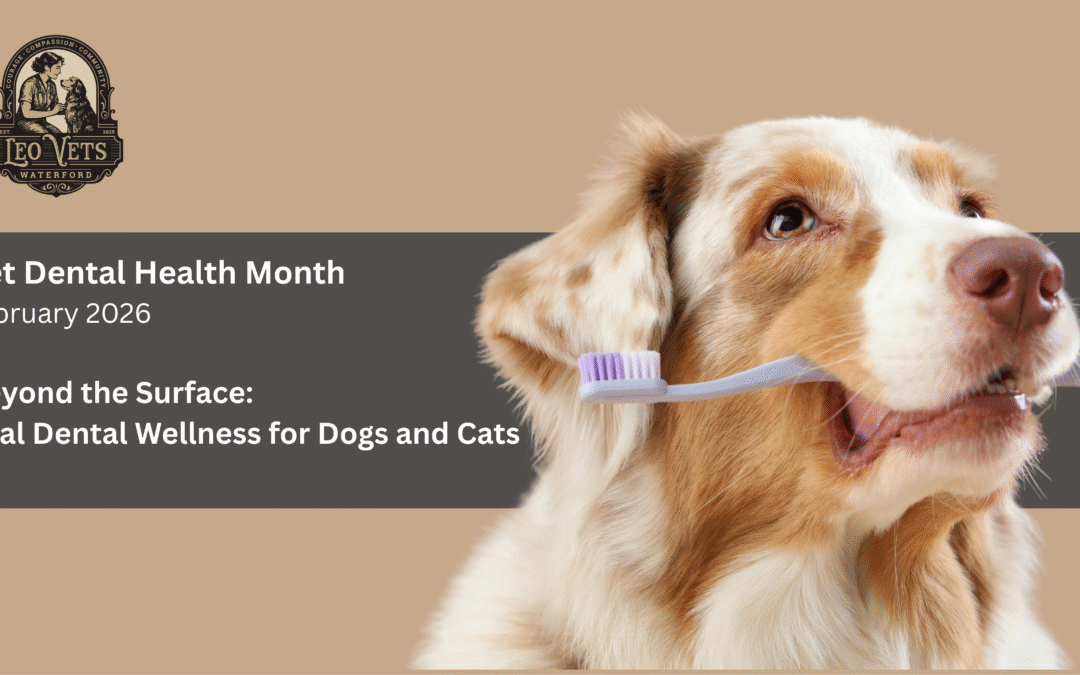
This February marks our very first Dental Health Focus Month at Leo Vets, and we’re celebrating with a two‑part blog series, a dedicated newsletter, and a fun, interactive client evening. If you’d like to join us for hands‑on demos, myth‑busting, and real‑life case stories, you can find all the details at leovets.ca/events
Even though our hospital doors won’t open until spring, we didn’t want to wait to start these important conversations. Dental health is one of the most overlooked parts of pet wellness, and yet it has a profound impact on comfort, energy, and longevity. Many pets look perfectly fine on the outside while dealing with significant disease beneath the surface. Our goal this month is to help families understand what’s really going on in their pets’ mouths and how we can work together to keep them healthy.
This is Part 1 of our series, focused on understanding dental disease and what a true veterinary dental cleaning involves. Part 2 will arrive later this month and will guide you through practical, realistic home‑care routines that fit your lifestyle and your pet’s personality.
Dental Disease: Quiet, Progressive, and More Serious than it Looks
Dental disease is not a cosmetic issue. It is a chronic infection driven by anaerobic bacteria that thrive in the oxygen‑poor space beneath the gumline. These bacteria trigger inflammation, damage bone, and weaken the ligaments that hold teeth in place. Over time, this infection affects the entire body.
Many people assume dental disease appears late in life, but over 80% of our furry companions will develop some degree of it by the age of three! Pets rarely show obvious signs. Animals by nature hide pain. They continue eating, playing, and acting normally, even with significant discomfort. That’s why understanding the stages of dental disease is so important.
Stage 1: Gingivitis
Plaque builds along the gumline, causing redness and swelling. At this stage, the inflammation is limited to the soft tissues and can be reversed with proper care.
Stage 2: Early Periodontal Disease
Inflammation has moved below the gumline, and the early supporting structures of the tooth are beginning to weaken. At this stage, up to 25% of the bone and ligament attachment has been lost. Pets rarely show discomfort, but the infection is already progressing beneath the surface.
Stage 3:Moderate Periodontal Disease
The infection has caused measurable and permanent damage. Up to 50% of the bone and ligament support around the tooth has been destroyed. This level of loss is painful, even if pets continue eating normally. Many families are surprised to learn how much disease can be present without any outward signs.
Stage 4: Advanced Periodontal Disease
More than half of the supporting structures of the tooth are gone. The tooth is no longer stable, and the surrounding bone is severely compromised. Dogs, in particular, have long, deeply anchored roots, so teeth are not meant to “fall out.” When they do, it is because infection has essentially rotted away the foundation that was meant to hold them securely for life. This stage is significantly painful and requires surgical intervention.
This is why proper diagnosis and treatment matter. We cannot see the full picture without anesthesia, radiographs, and a thorough assessment of every tooth.
Inside a Veterinary “Dental Cleaning” (Its Medical Care, not Grooming)
A comprehensive veterinary dental procedure is called a COHAT, which stands for Complete Oral Health Assessment and Treatment. It is a structured, medical procedure designed to diagnose and treat dental disease both above and below the gumline.
Our new dental suite at Leo Vets will include the same type of diagnostic and treatment equipment you would expect at a human dental clinic, adapted for pets. This includes digital dental radiography, ultrasonic scaling, high‑speed drills, and advanced monitoring systems. Every anesthetic procedure is overseen by a Registered Veterinary Technician (RVT), a highly trained professional whose role in veterinary medicine shares similarities with a human nurse. Pain control is central to everything we do, including local nerve blocks, anti-inflammatory pain medication, and even laser therapy.
Here is what a COHAT looks like from start to finish
- Pre‑procedure assessment and planning
We begin with a full history and an awake oral exam. This helps us identify areas of concern and plan the procedure with your pet’s comfort and safety in mind.
- Gentle, fully monitored anesthesia
Your pet is kept warm, comfortable, and deeply relaxed. Anesthesia allows us to work safely below the gumline without fear, pain, or movement. An RVT monitors vital signs throughout the entire procedure.
- Initial photographs
We take clear images of your pet’s mouth before we begin. These help us document changes, explain findings, and show you exactly what we see.
- Full oral exam under anesthesia
With your pet fully relaxed, we examine every tooth and all surrounding tissues. We look for gum recession, pockets, fractures, masses, and resorptive lesions. Many of these issues cannot be detected in an awake pet.
- Probing and charting
A periodontal probe is used to measure the depth around each tooth. This is how we determine the stage of periodontal disease. Deep pockets indicate bone loss and infection beneath the gumline. Every finding is charted tooth by tooth.
- Full‑mouth dental radiographs
Radiographs are essential. More than half of dental disease hides below the surface. X‑rays allow us to see:
- bone loss
- root fractures
- tooth root abscesses
- impacted or retained teeth
- resorptive lesions
- infection around the roots
These findings guide treatment decisions and ensure nothing is missed.
- Scaling above and below the gumline
We use ultrasonic and hand instruments to remove plaque and tartar from the crown and, most importantly, from the root surfaces. This is where anaerobic bacteria thrive. Cleaning below the gumline is the only way to treat the infection.
- Polishing
Polishing smooths the tooth surface after scaling. This slows down future plaque accumulation and helps maintain oral health.
Dental Surgery: When a Tooth Cannot be Saved
Once the teeth are clean and radiographs are reviewed, we determine whether any teeth are no longer viable. A tooth may need to be removed if it is:
- infected
- fractured
- loose due to bone loss
- causing chronic pain
- impacted or resorbing
Surgery is never our first choice, but when a tooth cannot be saved, removing it relieves pain and prevents ongoing infection. Pets feel dramatically better once diseased teeth are gone. We perform local nerve blocks for comfort, use high‑speed dental drills for precision, and take post‑extraction radiographs to confirm complete removal. We also take photos so you can see exactly what was treated.
Why Anesthetic-free Dentistry isn’t Enough
Anesthetic‑free dental cleanings are often marketed as gentle, natural, or low‑stress. They can look appealing, especially for pets who seem nervous or for families who worry about anesthesia. The problem is that these procedures only remove visible tartar. They do nothing for the infection happening under the gumline.
Dental disease is an infection with anaerobic bacteria. These bacteria live in the oxygen‑poor space between the tooth and the gum. They cause inflammation, destroy bone, and weaken the ligaments that hold the teeth in place. None of this can be reached or treated in an awake pet.
Anesthetic‑free cleanings can create a false sense of security because the teeth look cleaner on the surface. Meanwhile, the disease continues to progress underneath. We often see pets who had “cleanings” elsewhere but still have advanced periodontal disease, loose teeth, or painful lesions that were never addressed.
This is why both the
AVDC (American Veterinary Dental College) https://afd.avdc.org/ and
CVMA (Canadian Veterinary Medical Association) https://www.canadianveterinarians.net/policy-and-outreach/position-statements/statements/veterinary-dentistry/
strongly discourage anesthetic‑free dentistry. True dental care requires:
- a full oral exam
- probing around each tooth
- radiographs
- cleaning below the gumline
- treatment of infected or damaged teeth
None of this is possible without anesthesia.
At Leo Vets, our goal is not just to make teeth look clean. Our goal is to treat the infection, relieve pain, and protect long‑term health. That requires proper veterinary dentistry.
What’s Coming in Part 2
Later this month, we’ll share Part 2 of our Dental Health series: a practical guide to home care. We’ll walk you through brushing, chews, diets, rinses, and realistic routines that fit your lifestyle. Prevention and post‑procedure care make an enormous difference, and there are many options to choose from.
We’re excited to help you build a plan that feels doable, gentle, and effective for your pet.
The Leo Vets Team — caring for healthy, clean mouths, every day.